Nanobes?

 
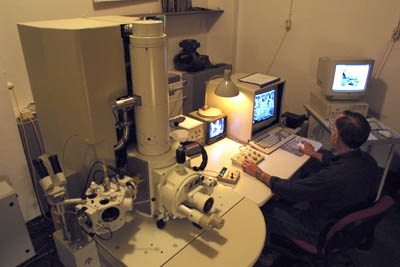
Wolfgang Heinen at the HOVO Wolfgang Heinen bij de HOVO

Wolfgang Heinen
July 11, 1928 - † June 30, 2006

Science:
article #1
article #2
Weidler et al. (abstract)
"I will observe a humble attitude and the springs will tell me their own stories"(WH)


A study on nanobes: introduction

Nanobes from a thermal spring in Badgastein In the last decennium with the availability of new powerful microscopic techniques the existence of life-forms smaller than 1 micrometer
(1 µm = 0.000 001 m = 1000 nm in which 1 micrometer is abbreviated to µm; and 1 nanometer becomes 1 nm) has become evident. With the discovery of these mitute organisms the impressively the discussion on the size limits for life has shown a revival. Meanwhiles cell-like structures with a size of a few decades of hundreds of nanometers, called nanobes, nano-bacteria, or nannobacteria, have been detected in almost all kinds of environments, ranging from common freshwater springs and thermal springs to carbonate deposits and sandstone deep below sea level. It has been proposed that nanobes present in the lithosphere (the outermost layer of the earth's crust) would be able to perform alterations of the chemical properties of neighbouring minerals, like is the case with sandstone-building bacteria. Not only in stones but also in pathological tissues nanosized bacteria-like structures have been found; they are presumed to be involved in calcification processes ocurring in blood vessels and kidneys.

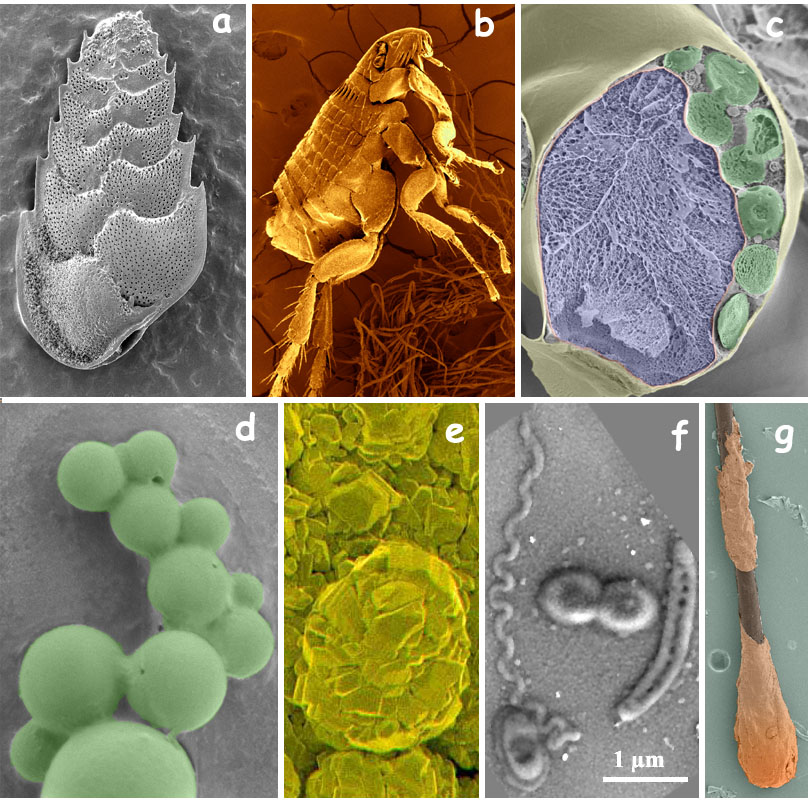
   Whether nanobes are truly independently living organisms, and no kristals, or remnants or parts (e.g. flagellae) of bacteria or other larger organisms, is still a matter of debate. Location of Bad Gastein in Austria Herebelow electron microscopy (fesem) images of nanobes are presented that come from thermal springs in caves located in Badgastein (Austria). These unpublished data come from the scientific heritage left by our dear colleague, Dr. Heinen, who passed away in June 2006. During many years, together with his assistent Anne-Marie Lauwers and electron microscopist Huub Geurts, Wolfgang studied a broad variety of microorganisms and putative nanobacteria (see colored structures in the SEM pictures hereabove) in biomats that had developped on pebbles or experimental substracts in the thermal water in the caves. Presently at the university of Salzburg a research project is conducted in which the relationship between the presence of DNA material and these nano-sized structures is investigated. Besides there are plans to combine structure-analysis with the FESEM with element analysis in order to unravel whether the observed nano-shapes consist indeed of organic material.

Hot springs

Thermal springs, like those at Badgastein, represent a part of a water-circulating process, lasting in this particular case for about 3000 years. The cycle begins with the melting of water from the the nearby glaciers. This water trickles down through fissures and pores of the rocks to deep-down pockets and chambers. In the depth, the bottom waters are heated up by the local temperature and the relatively high radioactivity, due to the presence of uranium minerals, initiating an upward flux, which eventually forces the water to emerge from the springs. During this circulation process, especially in the way up through capillaries and cracks, microorganisms harbored in the rocks can be taken along and transferred to the surface.
 
Thermal springs in Badgastein: sampling location and sampling
Entry gate to the Bad Gastein Franz Josef spring Entry of the Bad Gastein Franz Josef spring The Franz Josef gallery Bad gastein thermal baths: 15 th century historical print Sampling in a fissure with hot running water Binocular view of a loose piece of quarts stone form the thermal spring Coverglasses on which material was sampled for SEM analysis
[Heet water bronnen in Badgastein en monstername][Thermal springs in Badgastein and sampling
a Gate to the Franz-Joseph thermal spring in Badgastein (zoom)
b Entry sign of the Franz Josef spring (zoom)
c The Franz-Joseph gallery (zoom)
d a 15th-century print of the Bad Gastein thermal baths (zoom)
e Sampling of biofilms in a fissure from which hot water runs (zoom)
f Sampled quarts pebbles (zoom)
g Coverslips to sample microorganisms (zoom)

 
One of the main springs of the radioactive thermal springs at Badgastein is the "Franz-Joseph-Quelle". This spring can be reached through a gallery which was horizontally driven more than 100 m into the rock. The main spring delivers some 8000 liters of thermal water (45.6 °C) per hour. The water contains high amounts of aluminium (Al) and silicium (Si), medium amounts of potasium (K) and iron (Fe), but also appreciable quantities of magnesium (Mg), phosphor (P), sulphur (S), further calcium (Ca), manganese (Mn) and copper(Cu). The rock contains also a variety of uranium -derived- minerals, like radium (Ra-226) and radon (Rn-222). Several secondary springs with a much lower output (54 to 62 ml/min.) originate from cracks and fissures in the vertical rock surface next to the main spring. This location appears to be heavily colonized by lithobiontic microorganisms (and nano-organisms). Interaction with the substratum results in a weathering process, which can partly be followed by determining the leaching of silica and uranium from the colonized rock. In these springs water is delivered that has been in contact with the deep reservoirs inside the rock and numerous geological layers on the way to the surface. In this way elements and organisms from the rock-dwelling subsurface may have been transported to us by the hot water, like a space craft would do. The thermal springs thus provide a key to open a hatch to the hidden realm of the litho/biosphere.
 

Sampling for the FESEM analysis

For analysis in the scanning electron microscope (FESEM), samples were taken from the above-mentioned secondary springs, as well as from submerged quarts pebbles and fragments of rock (see photographs of pebbles made with the binocular). In addition, numerous SEM views were taken from round coverglasses that had been placed in the stream of hot water that pours out of the fissures. These coverglasses were clamped in a holder, so that one part of the glass surface that remained covered could serve as control, and the other would be left open to allow pebbles to be deposited and microorganisms to colonize the surface. Coverglasses were held for various time durations (days, weeks, months) in the water in order to investigate the colonization process overtime. As an additional indication for the presence of -combustible!- organic material the same FESEM samples were scrutinized before and after a short exposure into a flame; microorganisms, unlike resistent material like rock, was expected to be selectively eliminated by this treatment.
 

Results

Because there is no way to preclude whether nano-sized organisms will partake in all stages of the build-up of a microbial mat, all possible phases of biofilm formation were explored by microscopy. From such structural studies it is impossible to determine which type of organisms are populating the thermal springs. However, what could be clearly put into evidence was that a broad variety of microbes and nanobes was present in young as well as mature stages of colonization of the natural rocks and pebbles and experimental glass surfaces (illustrated here below in the figures 1 to 4. Variations in shape and size can be observed with a virtual magnifier in 5). When the bio-films were inspected under the scanning electron microscope at very high magnification, intricate honeycombed ribbon-structure were discovered, which are shown in part 6):
  • 1 Surfaces with early stages of colonization
  • 2 Surfaces with a developing biofilm
  • 3 Small mineral particles surrounded by, or embedded in a covering mat
  • 4 Mature biofilms adhering to each other with to the matrix
  • 5 Shapes and sizes
  • 6 honeycombed ribbon-structure
  • Scientific paper 1 (items 1 to 6) and paper 2 (item 6)

 
Results of investigations on nanobes in thermal springs
1. "Nanobes" in early stages of colonization
Colonization by nanobes
a. Biomat with a.o. filaments lined up by beads with sharp edges (possibly inorganic crystalline 'excretates').
b. A multitude of beads (20-60 nm diameter) on a mineral surface, which locally align to short rods (colorized).
c. Spirilla (60-110 nm diameter) and small rods (<400nm x <200nm).
2. "Nanobes" in a developing biofilm
Biofilm in development: nano-bacteria Filaments: Long but narrow filaments (70, 100, 140 nm diameter) and short rods (600-700 x 340 nm) with pili (arrows). Also "normal-sized" cells are present (not shown here).
3. Mineral particles surrounded by a mat
Mineral particles: mat cover Beads and chains: Beads (bar = 100 nm !) of 40 - 45 nm diameter forming normal and branched rows which together combine to a huge cluster.
4. Mature biofilm
Overview of the variety: Rods, single beads and beads in a row, filaments of various diameter, spirils, networks of regular-shaped structures build together a dense biomat.
Applet powered by Zoomify, requires java software to function. Free to download from Sun Microsystems
5. Shape and size of nanobes in mature bio-films
Details of the variety : in the biofilm spheric forms with a diameter of about 700 nm, long filaments with diameters varying from 180 to 220 nm, rods with micrometer-sizes and also the following smaller featureswere observed (see example here below): 1 Small cocci with diameters of 140-200 nm
2 Tiny Spirillae (70 nm diameter)
3 "Unidentified spherical structure with a "top" (710 nm diameter)
4 Very small beads (35 nm diameter)
5 Three cells forming a filament, each 280 x 145 nm
6 Very small rods (210x36 nm)
7 Filaments (180-210 nm diameter)
8 Ultrathin filaments (60 nm diameter and about 4500nm long)
9 Small rod

6. Honeycombed ribbon-structure at nanoscale
Honeycombed ribbon-structure nano-bacteria Ribbon-shaped honeycombed web: It is composed of small beads, which align to strings, merge to segments, and combine to tri-, tetra- and hexagons, which in turn arrange to the final ribbon structure. This intricate honeycombed ribbon-structure apparently represents an integral part of the mat community, because it was observed at many sites of the individual samples collected from various locations of the primary and secondary springs. Apparently the ribbons consist of organic matter, because they vanish after incineration. (scale bar = 100 nm!).
There are few examples for the existence of comparable features. One is a microbial fossil of undetermined identity dubbed "microcholla" (from its resemblance to the lignified skeletons of cholla cacti), detected in the now dry paleopools of Hidden Cave, NM, (Boston et al., 2001; Astrobiol. 1, 25-55).

Scientific article #2 by Heinen et al. entirely dedicated to these structures.
schema for the possible formation of honeycombed ribbon networks of putative nano-bacteriaScheme of the putative formation of above-shown honeycomb ribbon-shaped webs: The basic units for the web are beads of ca. 30 nm diameter (1), with the potential to merge to strings or segments. They can vary considerably with respect to the compounds they contain. Depending on which types of beads (A, B, C) align and merge, the resulting segments may differ greatly with regard to their properties (2). The two terminal spheres in a row of five are only by one third integrated into the unit, while the other two thirds belong as constitutional sections to the segments which branch off at both ends with a 45 degree angle (3, 3a, 4). This produces an intermediate Y-shaped structure (5), and delivers an upside-down-mirrored "Y" (6), which can further associate to hexagons (6). These in turn assemble horizontally (7) up to the width of the web (approximately 800 - 1000 nm), and apparently indefinitely in vertical direction, to accomplish the honeycomb-structure of the ribbon (8).


Paper 1: "Putative nanobacteria in biofilms from an alpine thermal spring"

The figures and the discussion topics reported here below are extracted from the scientific article #1 (pdf format, in English) by Wolfgang Heinen († June 30 2006), Huub Geurts and Anne-Marie Lauwers, entitled "Putative nanobacteria in biofilms from an alpine thermal spring".
 
Figure 1- SEM of "nanobes" from the Gastein spring
Fig. 1 nanobes SEM"Nanobes" in mature microbial mats and on less colonized surfaces
(A) A well-developed mat with still recognizable individual members: 1) Cocci, 140-200 nm diameter; 2) Spirillum, 70 nm diameter; 3) unidentified spherical structures with a "top", 710 nm diameter; 4) beads, 35 nm diameter; 5) three cells forming a filament, each 280 x 145 nm; 6) very small rods, 210 x 36 nm; 7) filaments, 180-210 nm diameter; 8) ultra-thin filaments, about 60 nm diameter (these two are about 4.5 micrometer long, others are frequently twice or 3-times as long); 9) rods, 600 x 200 or 360 x 140 nm; 10) "normal" rods, 2.9 x 0.5 and 2.5 x 1.3 microm; (numbers refer to one or two locations only, but all features are present at various sites.) (B) Irregular mineral surface: 1) Dividing cocci, 250 x 220 nm diameter; 2) 4 cocci, 170 nm diameter, and a small rod 140 x 55 nm; 3) three very small cocci (embedded), 85 nm diameter; 4) small rods on mineral surface 225 x 140, 280 x 60 and 170 x 120 nm; 5) two longer rods, each 1.4 x 0.14 microm; 6) unidentified objects. (c) Colonization of a rock surface: Spirillum 60 about 10 nm diameter, and small rods 330 x 90, 240 x 50 and 380 x 190 nm. (The bar in all pictures represents 1.0 micrometer).

Figure 2- SEM of "nanobes" from the Gastein springFigure 3- SEM of "nanobes" from the Gastein spring
Fig. 2 nanobes SEM Short filaments
(A) Thin filaments (center) about 80 nm diameter, longer filaments 120 nm diameter; thin rods (e.g. left, off-center) 390 x 30 nm, very short rods (arrows left and lower right) 120 x 20 nm; curled rod 120 nm (arrow); spherical objects �1 micrometer diameter; rod 1.0 x 0.5 micrometer at upper left. B) Long filaments (70, 100, 140 nm diameter) and short rods (600-700 x 340 nm) with pili (arrows); spherical object 1.2 micrometer diameter); several "normal-sized" cells.
Fig. 3 nanobes SEMNano-sized features at various sites
(A) The larger filaments (130 nm diameter) are glued together for a short distance, then part again; thin filament (55 nm diameter) at the center, and directly underneath an even thinner filament (40 nm diameter) ending as a thread of 20 nm diameter; 50 nm filament with knots at the lower end (arrow). (B) 1) Small rods (125 x 75 nm) at upper right and a bit lower left; 2) beads near the center with 25 - 75 nm diameter; 3) two or three rods (about 30 x 80 nm) lined up in a row, and just above a longer rod with a bulbous end (180 x 80 nm, arrow); small rods are also recognizable in the cavity and in the ribbon below. (c) Cocci (150 nm diameter), rods (210 x 150, 230 x 160, 370 x 210 nm), and very thin rods (310 x 50 nm, arrows); many beads on the rock surface.

Figure 4- SEM of "nanobes" from the Gastein springFigure 5- SEM of "nanobes" from the Gastein spring
Fig. 4 nanobes SEM Beads on matrix-covered mats and other surfaces
(A) Biomat with embedded Spirillae, rods and filaments: Beads with sharper edges (possibly inorganic crystal-line "excretates") follow the shape of a filament. B) A multitude of beads (20-60 nm diameter) on a mineral surface; locally they seem to align to short rods (white arrows). C) Piles of coccoid forms of various sizes: In the left background beads with a diameter of 280 nm and elongated forms 490 x 560 nm, left of upper arrow 350 nm. The conglomerated small beads (arrows) show variations from 140 to 210 nm. D) Coccoid objects in a developing mat. The smallest with diameters from 220 to 480 nm (1) also appear as "diplococci" or "budding cells" (2), and apparently can either fuse or grow up to elongated forms (3) and spheres with diameters ranging from 750 to 1000 nm. E) Beads with approximately 30 nm diameter forming long "string of pearls", but frequently also curled-up chains (arrows), which often pile up to clusters (arrowhead); bigger-sized spheres are also present (black arrow and the smooth area lower left of the pile). F) Smaller clusters of shorter chains (arrow), with bigger beads in between (arrowhead). Insert: these beads are 40 to 55 nm in diameter and thus smaller than those in (D).
Fig. 5 nanobes SEM Beads and chains (bar = 100 nm !)
(A) Beads of 40 - 45 nm diameter forming normal and branched rows (arrow: Y-shaped chain) which together combine to a huge cluster. (B) This pile of threads and chains (20 - 60 nm diameter) apparently consists also of small beads (small white arrow); at some sites (center and right) a web-like structure seems to reveal; at upper right (arrow) nano-sized rods under a covering layer. (C) Strings with a diameter of about 35 nm, composed of tiny beads (detail from Fig. 4 E). These threads have the same principal build-up as the rows in B and especially A, and they also exhibit the tendency to form huge clusters (compare with Fig. 4 E, F).

 
Points of discussion and conclusions from paper 1
Our concept of the extension of the biosphere is again in a state of change since we have learned that "bacteria can penetrate rock", and that an entire realm of our planet, which had been considered to be sterile, is in fact teeming with life, representing a substantial part of the "unseen majority". By now we have at least some awareness of "the biosphere below", and begin to comprehend the consequences, including the concept that the nano-sized members of the community presumably represent structural-evolutionary steps towards the organizational level of present-day bacterial cells.
   Realizing the spatial dimensions of sub-surface environments (the holes, pores, cracks and fissures in the rocks), it is conceivable that the smallest forms of life would fit in most conveniently. The observation that Triassic and Jurassic rock from 3400 to 5100 m below the seafloor is anything but sterile, instead heavily colonized by nano-sized organisms, is one of many convincing examples for this concept. The nano-scale representatives of the biosphere also fit into such environments so well because they are obviously involved in quite a variety of geochemical processes.
In this respect, these springs represent an entry giving access to the biosphere below. Our results show, that the water brings up almost all the nano-sized features observed by other investigators /.../ It demonstrates that a remarkable fraction of the rock-dwelling community seems to be small-sized, and reflects the abundance, diversity and versatility, as well as the ubiquity of these subsurface nano-scaled forms of life. These observations also demonstrate that the search for possible life on planets or moons of our solar system should concentrate on the collection of subsurface samples instead of just scratching the surface.
 

Paper 2

The figures shown here below (to zoom in) are original images used in the scientific paper #2 (pdf format) by Wolfgang Heinen († June 30 2006), Anne-Marie Lauwers and Huub Geurts, entitled "A honeycombed web from microbial mats of a thermal spring, a conceivable model for the structural evolution of microbial entities via self-assembly of nano-structures?" Further general information on this electron microscopical study can be found on the start webpage on nanobes.
 
Honeycomb-shaped webstructures
Honeycomb-shaped web structure
Move the mouse over the picture to enlarge the view. If the magnifying function is lost, it can be reactivated by reloading the webpage (Refresh or F5 key).
Javascript: http://valid.tjp.hu/zoom

 
Figure 1- SEM of honeycomb-shaped web structure. Nanobes #2Figure 2- SEM of honeycomb-shaped web structure. Nanobes #2
Fig. 1 honeycomb-shaped web nanobes #2 Ribbons and long filaments
Ribbons of the web-structure as part of the microbial mat community, consisting mainly of long filaments with varying diameters. (A) Four ribbons can be distinguished within a small area (numbered arrows). The width of the ribbons is approximately 0.9 micrometer, their length cannot be defined: One ribbon appears from underneath at the lower edge of (B) and continues up to the rectangular "cross" of two filaments in (A), where it disappears in the mat. In these pictures most of the ribbons seem to follow the contour's of an underlying feature, probably a filament. (In all pictures the bar represents 1 micrometer, if not stated otherwise).
Fig. 2 honeycomb-shaped web nanobes #2Web-structure integrated into the microbial mat community
(A) Edge of a microbial mat attached to a mineral surface. The diameter of the smallest filaments is about 70 nm, the bigger ones of approximately 180 nm. Integrated in the mat is a ribbon starting at the left lower edge and continung horizontally (arrows). The web-structure is hardly recognizable because the meshes are filled with slipped-in material. Except for the middle part, the ribbon again seems to follow an underlying feature. (B) Mat community with clearly distinguishable microbes (rods 1.5 x 0.8 micrometer, cocci 1.1 x 0.7 micrometer, big filaments, spirillae and small filaments (diameter 300, 120 and 60 nm, resp.) and a ribbon (850 nm diameter) with a well-defined web-structure. In this case a "leading feature" underneath is not apparent.

 
Figure 3- SEM of honeycomb-shaped web structure. Nanobes #2Figure 4- SEM of honeycomb-shaped web structure. Nanobes #2
Fig. 3 honeycomb-shaped web nanobes #2Webs on the rocks
(A) Several ribbons as the only complex structural entity on a mineral surface. (B) The main web in the center (1) is accompanied by a shorter ribbon at the left (2), and an accumulation of at least two webs at the top (3). Where the main ribbon adheres to the rectangular pebble (upper white arrow) the hexagonal structure is disturbed, and at the small pebble at the center (black arrow) three tetragons are discernable (see also Fig. 7 A,B); the structures at the lower part (black arrows) are probably a continuation of the main ribbon. (C) Web on a rugged surface, nestling in clefts and fissures. Although the web is clearly visible, it is again impossible to decide where the structure begins and ends: the "infinite web".
Fig. 4 honeycomb-shaped web nanobes #2Accumulating webs occupying a large area
(A) A multiple layer of ribbons probably entangling an underlying object. From the center to the right the width of the web almost doubles. (B) The web is covering an area with a near spherical feature at the right. (C) Layers of webs at a site with different levels (and therefore locally a bit out of focus). In these pictures individual ribbons are rarely recognizable.

 
Figure 5- SEM of honeycomb-shaped web structure. Nanobes #2Figure 6- SEM of honeycomb-shaped web structure. Nanobes #2
Fig. 5 honeycomb-shaped web nanobes #2Hexagonal fine-structure of the web
(A) A honey-comb ribbon attached to a crystal surface (goethite); the rim of the fabric consists partly of alternating hexagons and trapezoidal tetragons. (B) A uniformly structured ribbon following the topography of an uneven surface (bar = 0.5 micrometer). (C) A hexagonal web on the smooth surface of a microbial mat. (D) A slightly concave (and therefore apparently smaller) web stretching from lower left to top over a second ribbon. (E) Even at a sharp edge, this ribbon follows the contours of the pebbles. (F) Webs on a quite even rock surface (hematite). Bar in (A) = 100 nm. Bar in (B) = 0.5 micrometer. Bars in (D) to (F)= 1 micrometer
Fig. 6 honeycomb-shaped web nanobes #2Deviations from the normal-sized hexagonal fine structure
Penta-, tetra- and trigons (A) in a partly double layered web on a rough surface and (B) in a ruptured web; in the upper region a few beads are recognizable. (C) The mesh-size of the web-structure (interspace) varies from very wide (at the center and left) to an extremely small width (two arrows). D) Big-sized hexagons at the upper right, somewhat smaller sizes (with penta- or tetragons) at the center left, and "normal-sized" mesh's (lower right). Similar variations are apparent in regions (1) and (3) of Fig. 3b. Obviously the web can be stretched in order to adapt to the aerial topography. (E) The segments forming the hexagonal structures become (from left to lower center, 3 arrows) increasingly inflated and thus initiate a greatly reduced interspace (compare web-width at upper left, white arrow). (F) Inflated web, partly with smaller interspaces, and irregularities in the structure of the segments (the arrows mark deteriorated parts of the structural entity). Bar in (A) = 100 nm, Bar in (B) = 0.5 micrometer, Bars in (C) to (F) = 1 micrometer

 
Figure 7- SEM of honeycomb-shaped web structure. Nanobes #2Figure 8- SEM of honeycomb-shaped web structure. Nanobes #2
Fig. 7 honeycomb-shaped web nanobes #2Variations of the shape of the ribbons
(A) The ribbon beginning with its normal appearance (lower right) is further up folding over a sharp ridge (arrow 1). After a 90 degree bend it curls on the upslope of a triangular pebble, and even more at the downslope, deflating to a compact strand with a diameter of 150 nm (arrow 2). Further to the left it resumes its normal structure. In the center (arrow 3), a part of the ribbon has totally collapsed; the remnants are partly discernible as a string of beads (arrow 4). (B) Twisting of the web (arrow 1, 2) leads to the formation of clusters (arrow 3), with bead-like components recognizable. The deflating area at left (4) arises from a folded (4a) and a �filled-up�ribbon (arrowhead). Bars = 1 micrometer
Fig. 8 honeycomb-shaped web nanobes #2Twisting, folding and piling up as huge clusters
The ribbon on a smooth mineral surface (A, arrow) begins to fold up after a downward turn on a rougher surface, and curls up to two connected clusters, with remnants of the web-structure visible between these piles (arrowhead). Within the crumpling clusters (B = detail from A) hexagons of various size are recognizable (arrows), but even more pronounced in (C). Short chains and longer loop-forming strings are characteristic for the cluster in (D).

 
Figure 9- SEM of honeycomb-shaped web structure. Nanobes #2Figure 10- SEM of honeycomb-shaped web structure. Nanobes #2
Fig. 9 honeycomb-shaped web nanobes #2Bead-like substructures and the formation of loops
(A) The bulk (center, right) consists of small strings (+/- 30 nm diameter) composed of tiny beads (better recognizable as individual rows or chains, arrows 1 = ~150 beads = 4.5 micrometer, 2 = ~84 beads = 2.5 micrometer). The strings show a tendency to form loops, frequently with an interspace close to that of the web-structures (arrows 3, 4, as examples); (B) beads at the upper rim, as part of the segments, within the interspace of a web, and very short strings; right foreground: clusters of nanobacteria (230 x 70 nm); (C) segments of an inflated ("puffed-up") web consisting of individual and lined-up beads (arrows); the beads also appear in the interspace of the ribbon structure.
schema for the possible formation of honeycombed ribbon networks of putative nano-bacteria Scheme of the putative formation of above-shown honeycomb ribbon-shaped webs
The basic units for the web are beads of ca. 30 nm diameter (1), with the potential to merge to strings or segments. They can vary considerably with respect to the compounds they contain. Depending on which types of beads (A, B, C) align and merge, the resulting segments may differ greatly with regard to their properties (2). The two terminal spheres in a row of five are only by one third integrated into the unit, while the other two thirds belong as constitutional sections to the segments which branch off at both ends with a 45 degree angle (3, 3a, 4). This produces an intermediate Y-shaped structure (5), and delivers an upside-down-mirrored "Y" (6), which can further associate to hexagons (6). These in turn assemble horizontally (7) up to the width of the web (approximately 800 - 1000 nm), and apparently indefinitely in vertical direction, to accomplish the honeycomb-structure of the ribbon (8).

 
Points of discussion from above scientific article #2:

    The "theoretical minimal size for a viable cell", in which all the indispensable ingredients (DNA, enzymes and other elements) can be harbored in a 20% to 70% water environment, is about 140 nm in diameter and 1.44 x 10⁻³ µm3 in volume (Maniloff 1997, Science 276, 1777). The majority of the nano-sized units presented in this paper are below this limit. The strategic solution to reach the level of a viable organism could be achieved by associating structural (sub-)units (in this case beads, segments and hexagons) to a coordinated and cooperating entity - probably an association of constituents with different properties. Is the "infinite web", a microbe composed of self-assembling nanobes (or at least nano-sized units), a conceivable model for what we define as "structural evolution"?
&nbps;

Links to further information on nanobes


Colophone

Scientific research: Wolgang Heinen and Anne Marie Lauwers (Department of Microbiology, University of Nijmegen).
Scientific collaboration: Helga Stan-Lotter (University of Salzburg) and co-workers (Weidler et al.; abstract of paper in Applied and Environmental Microbiology)
Electron microscopy: Wolgang Heinen, Huub Geurts and Geert-Jan Janssen (Department of GI)
Web-structure and lamascripts: Remco Aalbers
Webpages: Liesbeth Pierson
Contact: Email
Magnifier javascript: http://valid.tjp.hu/zoom

Acknowledgement

In his manuscript 'Nanobes 1', Wolfgang Heinen wrote: "A.M.L. and W.H want to express their gratitude to all officials at Badgastein, responsible for the attendance and maintenance of the thermal springs, who for years supported our activities at the Franz-Joseph-Quelle, especially Wassermeister Knoll and his coworkers (Wasserwerke). We are also very grateful to Dr. Alexandra Sänger (Dept. of Zoology, University of Salzburg, Austria) in her function as coordinator of the Forschungsinstitut Badgastein/Tauern region and as our guide to Austrian soul and spirit and other essentials. I (W.H.) also want to thank Professor Celestina Mariani, and all members of the Dept. of Experimental Botany, and the Dept. for General Instrumentation, Faculty of Science, University of Nijmegen, for their unwavering perpetual support, infinite patience and kind hospitality."

http://www.vcbio.science.ru.nl/en/fesem/applets/nanobes/print/

last modified: 17 Oct 2011